RvL


About Me

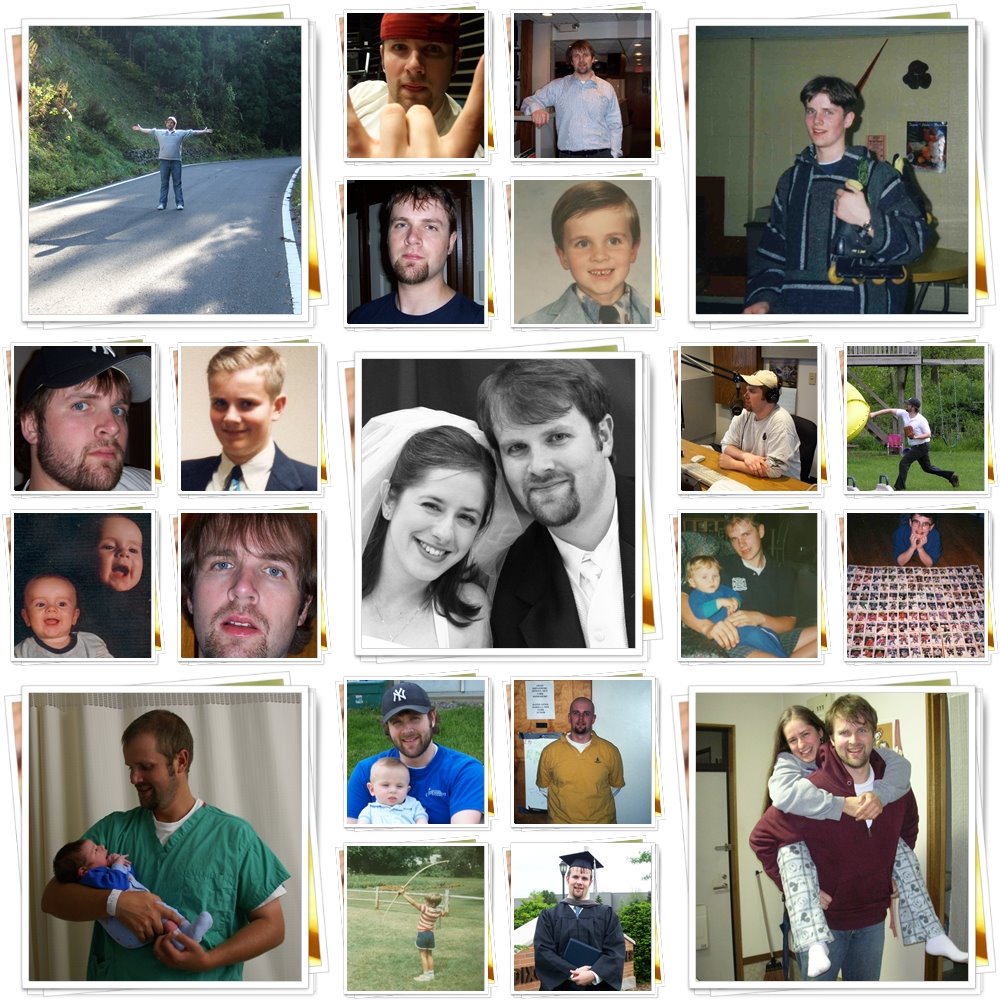
My photo
I’m from New York but my driver’s license lists that my address is Ohio. My passport has a number of stamps in it. I’m the youngest of six, yet oldest son. I have a number after my initials, but not my name. I like music. I like coffee, beer and bourbon. I am a follower of Jesus. I watch bonus features on DVD’s. For four months each year my wife and I are the same age. “I pledge allegiance to a country without borders, without politicians.” I am an ordained pastor, but don't currently have a church. I’ve eaten raw horse meat. I’m fifteen inches taller than my wife, but I look up to her. I still prefer buying CDs to downloading music. I’m a night owl, who doesn’t mind getting up early. I like to play games. I moved to another country nine days after my wedding. I sometimes quote random lyrics. I believe in miracles. I prefer desktops to laptops. I like listening to audio books. I watch Buffalo Bills and Sabres games. I have five sons. I'm living life mid sentence.

Sunday, January 11, 2026

Top 12 Books from 2025

Here are some of the books I listened to in 2025 that I thought were the best.


The Way We Never Were:  American Families and the Nostalgia Trap by Stephanie Coontz  

A lot of historical information is included, revealing what we think the “ideal” family looked like in the past is fictional.  Even the “ideal” 1950’s didn’t last, because it wasn’t real.    


 The Power Worshippers: Inside the Dangerous Rise of Religious Nationalism by Katherine Stewart  

For those who are concerned about how George Soros is funding the political Left, this book exposes those (including billionares) behind the religious Right. 


 The Anti-Greed Gospel: Why the Love of Money is the Root of Racism and How the Church Can Create a New Way Forward by Malcolm Foley  

Wow! This book lays out a case for how greed is at the heart of racism, as well as other sins.  The book is well thought out, and makes a good argument from the Bible on how our obsession with money continues to exploit people today. 


 The Honest Truth About Dishonesty: How We Lie to Everyone—Especially Ourselves by Dan Ariely  

 This entertaining and eye-opening book examines why people lie and how we justify our lies. I would highly recommend it for anyone who works in education or who is in leadership in a work environment.    


Everyone Who is Gone is Here: The United States, Central America, and the Making of a Crisis by Jonathan Blitzer   

An in-depth book on how the “crisis” in the U.S. now (think MS-13, “illegal immigration”, etc.) is mostly a result of past decisions by the U.S. An eye opening look at how the U.S. has created many of the problems that the current administration is blaming on others. 


The Secret Life of Groceries: The Dark Miracle of the American Supermarket by Benjamin Lorr  

The book was a fascinating look at the dark side of how we shop for food, and all of those trampled by the lower prices we pay.  One of the best books I’ve read this year. 


 The Warmth of Other Suns: The Epic Story of America’s Great Migration by Isabel Wilkerson  

From World War 1 until 1970 The U.S. had a mass migration of blacks fleeing the Jim Crow south for mostly northern, and some western, cities.  This book humanizes the migration by documenting three people, and by extension their families, as they fled inhumane conditions in the south in hopes of finding greener pastures.  This book made me angry at times and brought me to tears more than once.  It's a powerful book and well worth reading. 


 Caste: The Origins of our Discontents by Isabel Wilkerson  

Wow.  Wilkerson brings the receits on how the U.S. is more similar to India than I would have ever imagined.  In India their people are arranged by what caste they were born into.  America isn’t much different.  However, our castes are based on race.  Before you dismiss the concept, read the book.   


The Immortal Life of Henrietta Lacks by Rebecca Skloot  

Wow.  This book came to me via a recommendation (Tricia) and I’m grateful.  It’s a book that was both eye opening and for lack of a better term...convicting.  How much do I benefit from something that was taken from another, with or without the other person’s consent?  This book adds a face to the science laboratory in advancements that have helped save millions of lives.  And it tells the story of one family coming to grips with their loved one being at the center of billions of dollars of research and development, while their family is suffering and dying for lack of health coverage.    


Disarming Leviathan: Loving Your Christian Nationalist Neighbor by Caleb E. Campbell  

The American church has sent missionaries to people groups for centuries.  Effective missionaries learn about the culture and ways of those they seek to minister to, and then seek to come alongside them and point them towards Jesus.  In this book, Campbell, an Evangelical pastor, suggests that followers of Jesus should take the same approach in loving their MAGA and Christian Nationalist family and friends.  This book includes a lot of practical instructions and suggestions.  I probably should get a physical copy so I can underline and highlight the especially helpful stuff, instead of trusting my memory to bring the good suggestions to recall. 


A Problem from Hell: America and the Age of Genocide by Samantha Power  

This book looks at several genocides that have taken place since WW2, exploring the United States responses to these atrocities.  The U.S. usually was indifferent, if not on the side of the oppressors, when it came to such atrocities.  This book is a must read when it comes to foreign policy.    


 The Sun Does Shine: How I Found Life and Freedom on Death Row by Anthony Ray Hinton  

This should be viewed as a companion book to Bryan Stevenons’ book “Just Mercy”.  This is the story of a 29 year old Christian man who is wrongly convicted of a double murder in Alabama and sent to death row.  Hinton shares how he went from having a strong Christian faith, to throwing it all away in despair, to finding faith again.  To say the system of capital punishment is broken in the U.S. is an understatement.  Two take away quotes (or paraphrases) from the book are  “Those with no capital get the punishment”, and innocence of the person on death row is not a valid reason to reexamine the conviction (said by the assistant attorney general of Alabama).  When Hinton’s public defender was paid $1000 to defend Hinton, when he said he ate $1000 for breakfast, it shows that without deep pockets the chance of getting good defense suffers.   Also, consider that since 1973 about 1600 death row inmates have been executed in the U.S., and 200 death row inmates have been exonerated.  It’s time to reexamine our capital punishment system, and this book is a good place to start.    


Honorable Mentions:

The Many Lives of Mama Love: A Memoir of Lying, Stealing, Writing and Healing by Lara Love Hardin  

An eye opening, and at times heartbreaking story about how a soccer mom got mixed up with opioid addiction and wound up in jail.  If nothing else, this book shows flaws in the judicial system for those trying to get on the right path after their prison time ends.  Well worth reading. 


 The Kingdom, The Power, And The Glory:  American Evangelicals in an Age of Extremism by Tim Alberta  

I listened to this book (again) because my wife and I were going to see Alberta at a Holy Post event.  This book was extremely discouraging the first time through.  American Evangelical Christianity is voluntarily bowing down to politicians for a seat at the table.  However, on my second listen, I found more nuggets of hope than I remember from my first listen. 


 All My Knotted Up Life: A Memoir by Beth Moore  

A moving biography.  From being a survivor of abuse as a young girl, to becoming a well-known speaker, to losing support for speaking out against Trump’s sexual braggadocio.  The story is personal and is relatable in many ways.    


How Far to the Promised Land:  One Black Family’s Story of Hope and Survival in the American South by Esau McCaulley  

A powerful (recent) story of a black man growing up in the South.  This book moved me to tears on multiple occasions.    


100+ Books in 2025 (81-103)

 A Promised Land by Barack Obama 

A memoir of the first two years of Obama’s presidency.  Obama gives a behind the scenes look at not only what decisions he made, but why he made them.   


The New Jim Crow: Mass Incarceration in the Age of Colorblindness 10th Anniversary Ed. By Michelle Alexander 

I returned to listen to this book yet again.  It had probably been a decade since I first listened to it.  This book is a must read.  It takes a deep dive into how we wound up being the country with the highest incarceration rate, and how it was intentional by those in power.   


The Education of an Idealist: A Memoir by Samantha Power  

A long, yet interesting memoir of former U.S. Ambassador to the U.N., Samantha Power.  It added a personable take on the inner workings of a political insider. 


The Justice of Jesus: Reimagining Your Church’s Life Together to Pursue Liberation and Wholeness by Joash P. Thomas 

This book looks at church history, exploring how colonization in the global south has warped Christian understanding and theology.   


Five Views on Biblical Inerrancy by J. Merrick editor  

This is part of the Counterpoints: Bible and Theology collection of books.  This book brings together 5 theologians who have varying takes on the inerrancy of the Bible.  I found a few of the contributors to be more convincing than the viewpoint I held for the first several decades of my life.   


Lord Foulgrin’s Letters by Randy Alcorn 

A modern take on C.S. Lewis’ Screwtape Letters.  Alcorn is an author I greatly appreciate. However, I found this book to fall into a trap of oversimplifying and stereotyping different people.  I don’t think the book would have suffered if the characters had been more nuanced, instead of being the worst possible versions of their stereotypes.   


Who Killed Truth?: A History of Evidence by Jill Lepore 

Living in a society where some say we are in a time of “post-truth” Lepore, a trained historian, looks at key moments that have led us to where we are today.  I wasn’t expecting this audiobook to be more in the format of a podcast, but it did make it an enjoyable variation from most of the books I listen to.   


The Christian Imagination: Theology and the Origins of Race by Willie James Jennings 

Christians are called to love their neighbors.  But, throughout history, many Christians and Christian cultures have a bad track record of looking out for our own interest instead of loving and caring for the marginalized.  This book looks at the historical reasons we are where we are today.   


The Immortal Life of Henrietta Lacks by Rebecca Skloot 

Wow.  This book came to me via a recommendation (Tricia) and I’m grateful.  It’s a book that was both eye opening and for lack of a better term...convicting.  How much do I benefit from something that was taken from another, with or without the other person’s consent?  This book adds a face to the science laboratory in advancements that have helped save millions of lives.  And it tells the story of one family coming to grips with their loved one being at the center of billions of dollars of research and development, while their family is suffering and dying for lack of health coverage.   


 Time for Socialism: Dispatches from a World on Fire, 2016-2021 by Thomas Piketty 

This book is a series of essays and opinion pieces by Friench economist Piketty.  I was able to loosely follow his thoughts and rationale, but not fully.  After all, he was talking about the French economy and as someone who is not up to date on the economies of members of the E.U., I often found myself trying to catch up.  That aside, I did find some good criticisms of unfettered capitalism.  I’m not sure exactly how this book wound up on my radar, but it wasn’t one of the worst books I’ve encountered this year. 


Disarming Leviathan: Loving Your Christian Nationalist Neighbor by Caleb E. Campbell 

The American church has sent missionaries to people groups for centuries.  Effective missionaries learn about the culture and ways of those they seek to minister to, and then seek to come alongside them and point them towards Jesus.  In this book, Campbell, an Evangelical pastor, suggests that followers of Jesus should take the same approach in loving their MAGA and Christian Nationalist family and friends.  This book includes a lot of practical instructions and suggestions.  I probably should get a physical copy so I can underline and highlight the especially helpful stuff, instead of trusting my memory to bring the good suggestions to recall. 


 Don’t Let Nobody Turn You Around: How the Black Church’s Public Witness Leads Us out of the Culture War by Justin E Giboney 

A good reminder of how black Christians have used their public witness to spread love over the last 70 or more years.  A good starting point for those not well acquainted with the traditions and witness of Black churches in the U.S.   


A Problem from Hell: America and the Age of Genocide by Samantha Power 

This book looks at several genocides that have taken place since WW2, exploring the United States responses to these atrocities.  The U.S. usually was indifferent, if not on the side of the oppressors, when it came to such atrocities.  This book is a must read when it comes to foreign policy.   


Morality, Law and Justice in the Bible by Daniel L. Smith-Christopher 

This audiobook is a series of lectures, compiled into one volume.  It explores a number of modern ideas of what “justice” means and then explores what the Bible says about it.  As I learned earlier this year when I listened to the whole Bible in just a few weeks, the Bible says a lot more about justice than most Evangelicals in the U.S. realize.  There were many “oh, wow” moments for me in this book. 


Making Sense of the Alt-Right by George Hawley 

A history of the origin and rise of the “alt-right” and its role in the age of MAGA.  I think this book was well written, and more evenly handed than I expected. 


The Sun Does Shine: How I Found Life and Freedom on Death Row by Anthony Ray Hinton 

This should be viewed as a companion book to Bryan Stevenons’ book “Just Mercy”.  This is the story of a 29 year old Christian man who is wrongly convicted of a double murder in Alabama and sent to death row.  Hinton shares how he went from having a strong Christian faith, to throwing it all away in despair, to finding faith again.  To say the system of capital punishment is broken in the U.S. is an understatement.  Two take away quotes (or paraphrases) from the book are  “Those with no capital get the punishment”, and innocence of the person on death row is not a valid reason to reexamine the conviction (said by the assistant attorney general of Alabama).  When Hinton’s public defender was paid $1000 to defend Hinton, when he said he ate $1000 for breakfast, it shows that without deep pockets the chance of getting good defense suffers.   Also, consider that since 1973 about 1600 death row inmates have been executed in the U.S., and 200 death row inmates have been exonerated.  It’s time to reexamine our capital punishment system, and this book is a good place to start.   


The Myth of Good Christian Parenting: How False Promises Betrayed a Generation of Evangelical Families by Kelsey Kramer McGinnis and Marissa Franks Burt 

This book is more of an overview of more than a hundred Christian books on parenting.  The authors explore what the books teach, the promises they make, and look at the effects attempting to put these teachings into practice had on both parents and children.   


The Missionary Kids: Unmasking the Myths of White Evangelicalism by Holly Berkley Fletcher 

Fletcher, a Missionary Kid herself, does a dive into the lives and experiences of MK’s.  This book shows the complicated experiences of MK’s, and shows the sometimes seedy underbelly of evangelical missions.   


Holy Hurt: Understanding Spiritual Trauma and the Process of Healing by Hillary L. McBride Ph.D. 

Spiritual trauma can be real.  That is the starting point of this book, by Psychologist Hillary McBride.  The author looks at how religious circles can cause trauma, and offers suggestions of how to overcome these hurts.   


The Spirit of Justice: True Stories of Faith, Race and Resistance by Jemar Tisby 

An overview of Christians in U.S. history who spoke up against racism and racist practices.  


 As Long as You Need: Permission to Grieve by J.S. Park 

Wow.  A book by an evangelical chaplain at a large hospital about the difficulties of life amongst the terminally ill.  This book had me in tears numerous times.  Well worth the read.   


Abba’s Child: The Cry of the Heart for Intimate Belonging by Brennan Manning 

Another great Manning book.  This book explores how we are called to be the beloved of Jesus, and how He loves us regardless of our own misgivings.   


The Many Lives of Mama Love: A Memoir of Lying, Stealing, Writing and Healing by Lara Love Hardin 

An eye opening, and at times heartbreaking story about how a soccer mom got mixed up with opioid addiction and wound up in jail.  If nothing else, this book shows flaws in the judicial system for those trying to get on the right path after their prison time ends.  Well worth reading. 

Wednesday, December 03, 2025

Learning Who I Am

I’m an introvert.  Not an awkward, staring at my own shoes kind, but one nonetheless. This has surprised people over the years.  I’m talkative; often too talkative.  I don’t hate social gatherings.  Sometimes social gatherings can be energizing.  But, for me, a little goes a long way.   

This took me a long time to figure out.  In high school and during my multiple stretches in college I was often surrounded by my peers.  I spent a lot of time hanging out with friends.  Then, in my between college and post college years, I had little to no interactions with my peers.  It took me a while to figure out what I need to thrive. 

I’ve learned that social interactions are kind of like sunshine or food.  You can live without them for a while, but you won’t be healthy.  But too much of either are also bad for one’s health.  For me to thrive, I need occasional interaction but I need much less than most.   

There are exceptions.  I enjoy being around my wife and kids.  When I travel for work, I am OK, but I would prefer to be at home with them. When I am away, I sometimes add a phone call with a friend, in addition to calls to my wife and kids, but apart from that I'm usually content. 
 
For the past couple of days I’ve sat in a hotel, hundreds of miles away from home.  This wasn’t a planned stay.  So, I didn’t plan on a lot of down time. This time has confirmed what I have learned about myself.  I’m enjoying the downtime, but I would prefer to be home with my family.   
 
I have changed over the years.  I’m more comfortable in my own skin now than I was over the first 40 years of my life.  I’m more comfortable with a very small circle of friends than I was in the past.  And, who knows, maybe in the future I’ll become more extroverted.  That would be OK as well.  It takes time and energy to learn who you are.  And it took me decades to be ok slowing down to learn who I am.  And most days, I like myself. 

Thursday, October 02, 2025

100 Books in 2025 (61-80)

(Sorry about the formatting issues.  I tried to clean it up, but it kept having issues.) 


A Duty to Resist: When Disobedience Should Be Uncivil by Candice Delmas 

        A philosophical book on when people have a responsibility to stand up to injustice.  The author explains four criterion when resistance is necessary:  A duty of justice, principle of fairness, the Samaritan duty and Political associate.   


The Language of God: A Scientist Presents Evidence for Belief by Francis S. Collins 

        Colllins, a medical doctor and world-renowned scientist, shares how his scientific views (what some might call theistic evolution, but he prefers to call BioLogos) and his evangelical Christian faith are not at odds.   


Bad Faith: When Religious Beliefs Undermine Modern Medicine by Paul Offit M.D. 

        Dr. Offit lays out how misinformation, along with fear, are leading some religious families to shun         modern medicine (not limited to vaccines) and how some children suffer and die needlessly as         a result.   


Vaccinated: From Cowpox to mRNA, The Remarkable Story of Vaccines by Paul Offit M.D. 

        A biography, of sorts, of Maurice Hillerman.  Hillerman played a major role in creating many                vaccines that have helped to eradicate many common, but dangerous sicknesses.  It is also a                    cautionary tale about how vaccinations helped to eradicate some diseases, but lower vaccination            rates are seeing a reemergence of some diseases that were almost extinct. 


Chronological NLT (New Living Translation) Bible 

        I listened to the whole Bible, first time chronologically, over 3 weeks.  Listening to it as quickly as I did give a very different feeling than slower reading.  Maybe because it was in a translation I’m         not used to or maybe due to the speed, I picked up on some interesting things (Joseph and Esther to name a few) that I’d missed before.   


George Lucas:  A Life by Brian Jay Jones et al 

        A fascinating biography of Lucas.  Lucas comes off as an intensely focused man, in both good and bad ways.  His determination lead him to demand creative control over many of his projects (Star Wars) and yet his hyper focus caused him to lose his marriage.   


The Crisis of Zionism by Peter Beinart 

        A chilling book about how Israel can hold on to power or democracy, but not both.  The author lays out how Israel’s long term ruthless actions towards non Jews living in their country, both Arab citizens and non-citizen Palistinians, goes against God’s call for how we are to treat our neighbors, and goes against claims that they want a democracy.  This book came out in 2012, and         Israel’s actions have only gotten worse since its release.   


 The Evolution of Everything: How New Ideas Emerge by Matt Ridley 

        Ridley lays out how he believes things change from the bottom up, then from top down.  He gives examples from science, philosophy, technology, morality, economics, politics and more to show how many changes were inevitable based on changes going on all around.  I found some parts of the book interesting, and others less so.   


These Truths: A History of the United States by Jill Lepore 

        American History is not an easy subject to approach.  What you include, or exclude, will upset certain groups.  I found this book to be very even handed (this book is 960 pages, or 29 hours of audio), and 2/3 the way through the book I still couldn’t tell if the author had a “conservative” or             “liberal” take on history.  In the end, I learned a number of new things.  Some I feel surprised         I didn’t know before now, especially since some happened in my lifetime.  I think the book is             worth the time. 


The Warmth of Other Suns: The Epic Story of America’s Great Migration by Isabel Wilkerson 

        From World War 1 until 1970 The U.S. had a mass migration of blacks fleeing the Jim Crow south         for mostly northern, and some western, cities.  This book humanizes the migration by documenting three people, and by extension their families, as they fled inhumane conditions in the         south in hopes of finding greener pastures.  This book made me angry at times and brought me to             tears more than once.  It's a powerful book and well worth reading. 


White Trash:  The 400-year Untold History of Class in America by Nancy Isenberg 

        An interesting take on classism throughout U.S. history.  The author documents how there have always been the “upper” class, and “lower” class in our nations history.  


Caste: The Origins of our Discontents by Isabel Wilkerson 

        Wow.  Wilkerson brings the receits on how the U.S. is more similar to India than I would have ever imagined.  In India their people are arranged by what caste they were born into.  America isn’t much different.  However, our castes are based on race.  Before you dismiss the concept, read         the book.   


 Loaded: A Disarming History of the Second Amendment by Roxanne Dunbar-Ortiz 

        A book about the 2nd Amendment by someone who was once obsessed with guns, and now is skeptical.  That alone had me intrigued, since it follows a path I’ve gone down.  The book is more balanced than I expected, and gives a lot of facts about what led us to where we are today.  For         example, as I only learned in recent months, the NRA was in favor of stricter gun laws until the late ‘70’s and early ‘80’s.  And staunch conservative Supreme Court nominees, such as Bork, argued he didn’t believe Americans had a constitutional right to own guns.   


Beating Guns: Hope for People Who are Weary of Violence by Shane Claiborne and Michael Martin 

        A book for Christians by Christians about the United States obsession with guns.  In the book the authors seek to blend their theological opposition to the obsession, with the humanizing of those who have been victims of gun violence in recent years.  Possibly to the surprise of some, the book does not advocate for a complete ban on guns (multiple times they advocate for a limit of buying 1 handgun a month).  Instead, the book seeks to promote the Kingdom of God by longing for a time when weapons of war will be turned into garden tools.   


The Third Harmony: Nonviolence and the New Story of Human Nature by Michael N. Nagler 

        While not a book directly tied to guns, this completed the trifecta of books I read regarding the                 problem of violence.  Nagler promotes nonviolence, not only as a lack of violence, but to change             the hearts of humans in how they view others.  This books points out how the teachings of Jesus,             Ghandi, MLK and many others have shown us that we do not have to resort to violence to achieve          a more peaceful world. 


Punished by Rewards: The Trouble with Gold Stars, Incentive Plans, A’s, Praise and other Bribes by Alfie Kohn 

        The overall premise of the book is to show how we have been taught to incentivize those under us         to “do” more/better is to bribe them is wrong.  Bribing people to do what we want them to do may         work in the short term, but has negative effects in the long run.  Instead of helping them love what         the briber hopes they will love, education, reading, finding purpose in their work, instead it usually         leads people to do the minimum to get the reward.  And, even those who enjoyed the task ahead of         time, often find less joy in the same task after a reward in promised or given.  


On Call:  A Doctor’s Journey in Public Service by Anothony Fauci M.D. 

        An autobiography by Fauci, documenting his 5+ decades in public service.  Going into the book I             knew little about Fauci, apart from hearing him demonized by some for his handeling of Covid.              This book filled in the long, and storied history of his work.  Fauci was instrumental in helping             advance treatment of HIV/AIDS, as well as playing a large role in helping the U.S. through scares         with Ebola, SARS, West Nile and anthrax crisises—before being asked to help with the Covid19             pandemic.  The book is dry at times.  But, overall, I found it interesting.  He had good working             relationships with several Presidents and speaks most glowingly about his relationships with                 Republican administrations.   


The Cost of Ambition: How Striving to Be Better Than Others Makes Us Worse by Miroslav Volf 

         This book compares the teachings of Kierkengaard, John Milton and the Apostle Paul on ambition. As followers of Jesus, are we driven more by a desire to achieve excellence, or do we strive to be superior to others?  One is a noble endeavor; the other is not.     


History Matters by David McCullough 

        After his death, historian David McCullough’s daughter and a research assistant compiled                   unpublished essays and writings on why history matters.  The book gives an interesting behind the         scenes look at one of Americas better known historians. 


From Dropout to Doctorate: Breaking the Chains of Educational Injustice by Terence Lester, PhD 

        A moving memoir about how Lester struggled to overcome many obstacles, including                           homelessness, to beat the odds.  There was a lot of good information about educational inequality             and how poverty affects many in our country. 


Sunday, September 21, 2025

It's Complicated. It's Messy.

 It’s complicated.  It’s messy.   

Recently I listened to the entire Bible, yes all 74 hours, over the course of about 3 weeks. In the past, I would read the Bible in smaller chunks.  Sometimes I would complete a reading of the Bible in a year.  Sometimes it would take me multiple years.   Reading the Bible the way I recently did was different for me than my past readings. I noticed things I’d missed in the past, recognized patterns woven through the text, and was reminded that the people and events written about in the Bible are complicated and messy. 
 
Over the decades that I have been reading the Bible, I’ve come to appreciate that the Bible shows people as complicated beings.  It doesn’t airbrush their flaws.  It doesn’t cover up their sins.  It shows that men and women of faith also said and did some terrible things.  It also shows that some bad characters did good things.  It would be much easier if the Bible had painted the good characters/events as always being good, and the bad characters/events as always being bad.  Such binary would have been more compatible with how many of the people I grew up with viewed their religion, and people/events in general.   

In the Bible we read Abram/Abraham’s faith as God asks him to pack up and leave his homeland for an unknown land.  But we also see Abraham lying about his wife to try and safe his own life.  We read about Moses’ faith in leading the children of Israel, but we also read about his anger and murdering of an Egyptian. David is said to have had great faith, yet he was a lousy father and murderer to boot.  Simon Peter swings from moments of great faith to seeking political power, drawing praise and ire from Jesus respectfully.   

If the Bible doesn’t scrub the undesirable parts of its characters, we shouldn’t either.  It’s ok to feel conflicted regarding the legacy someone leaves behind.  David did some pretty nasty things.  And yet both Samuel and David say that David was a “man after God’s own heart.”  I don’t feel comfortable absolving David for all of his sins.  And thankfully, I don’t have to.  The Bible acknowledges the tension between the man of faith and the sinner, and I think it's OK if we do as well.  After all, it’s complicated.  It’s messy. 

Multiple public figures have died in recent months that were well known in the circles I’ve spent time in over my 47 years.  Many of them were mixed bags.  Some spoke fervently about Jesus, and in those regards I usually was in agreement.  But there were other beliefs put forth by these individuals that were at odds with my understanding of the Bible.  Some of their beliefs, I believe, are in opposition to the teachings of Jesus.  So, how should I respond?  One of these figures I called out many years ago, saying that even correct doctrine without love is to be in error.  I received harsh criticism from someone close to me, saying that calling out such a person shows a “lack of respect” for those that came before me.  I have no desire to disrespect others.  However, I’m also not comfortable scrubbing the negative aspects of such people just to appease their followers.  As a follower of Jesus, “The way, the truth and the light”, I believe that truth—the whole truth—is important.  
 
I have said and done a lot of things I am not proud of in my 47 years on this earth.  When I become aware that I’ve gone too far, or said something hurtful, I try to respond in a way that is consistent with my stated ethics.  I’m sure I fail and fail often.  I’m sure there are many circumstances where I am not even aware I was wrong.  After all, life is complicated.  Life is messy.  Yet, I don’t want to throw my hands up and say, “oh well.”  I hope to live by the philosophy that people do not scrub the bad I did, just to not speak anything negative about the dead.  If I want people to speak kindly of me in death, I need to live a life that reflects that.  If I want people to remember only the good, I need to work hard to correct my mistakes before my life is over.  But I realize that both the good and bad I’ve done are part of my story. After all I’m complicated.  I’m messy.